

20 Must-Have Magento Ecommerce Features for 2026 to Increase Sales, Conversions & Customer Experience
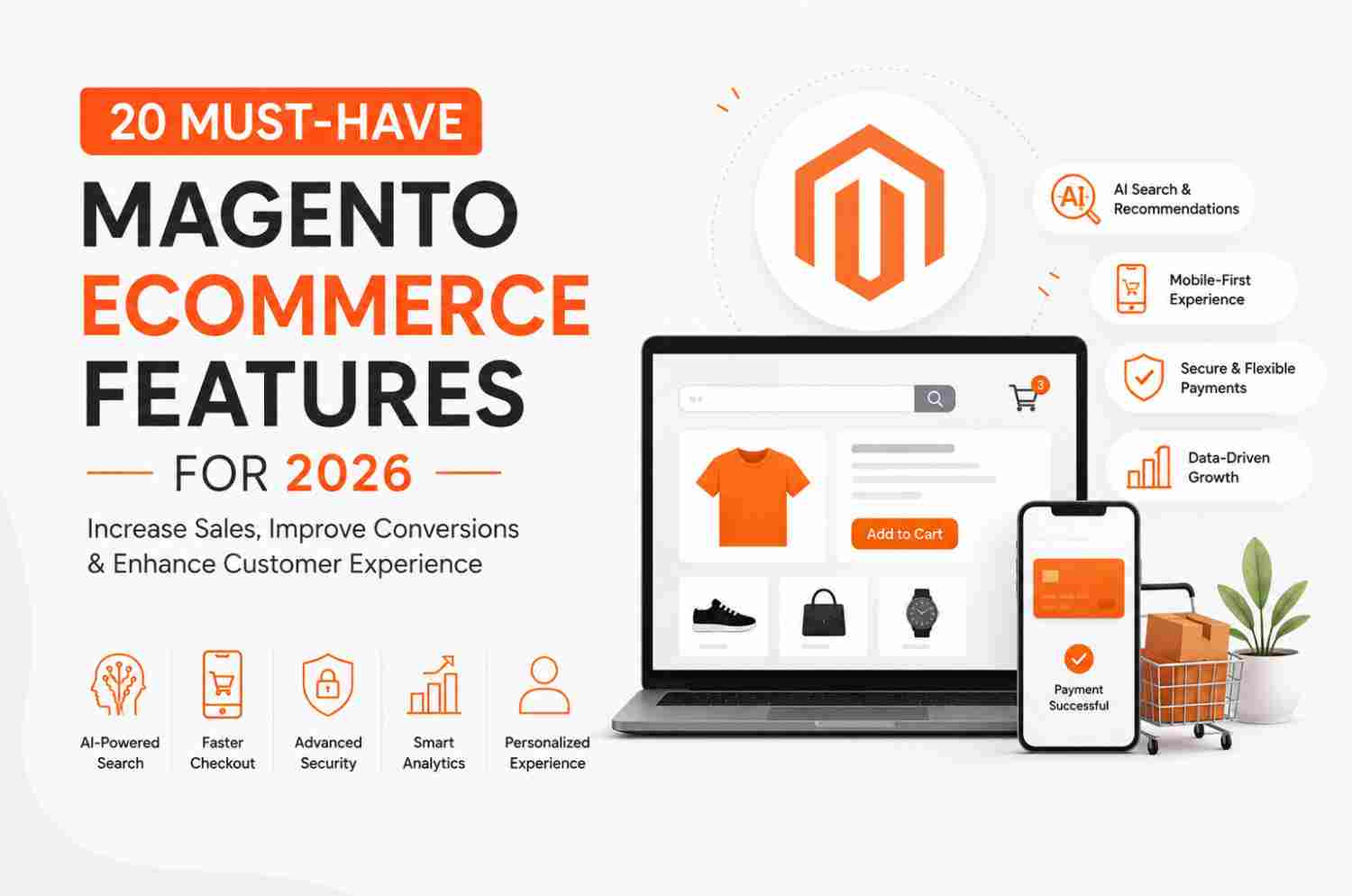
Magento ecommerce in 2026 is no longer just about selling products online. Customers expect faster websites, smarter search, personalized recommendations, flexible payments, simple checkout, real-time delivery information, strong security, and increasingly intelligent shopping experiences.
For Magento and Adobe Commerce merchants, adding the right features can directly improve sales, conversions, customer satisfaction, and long-term customer value. However, the goal should not be to add every available technology. The goal is to identify the features that remove friction from the buying journey.
In this guide, we explore 20 important Magento ecommerce features for 2026 that can help businesses build a faster, smarter, more secure, and high-converting online store.
1. AI-Powered Semantic Search
Traditional ecommerce search depends heavily on keywords. Modern shoppers, however, often search using natural language.
For example, a customer might search for "comfortable shoes for long-distance walking" instead of searching for a specific product name.
Semantic search attempts to understand the meaning and intent behind a search instead of simply matching individual words.
Important Search Features
- Natural-language search
- Typo correction
- Synonym recognition
- Search suggestions
- Intelligent product ranking
- Dynamic filters
- Zero-result search analysis
- Search analytics
Better search means less frustration and more product discovery. When customers can quickly find what they need, the possibility of conversion increases.
2. AI Product Recommendations
Product recommendations are becoming much more sophisticated than the traditional "Related Products" section.
AI-powered recommendation systems can analyze shopping behavior, product relationships, purchase history, and catalog information to present products that are more relevant to each shopper.
Recommended Locations
- Homepage
- Category pages
- Product pages
- Shopping cart
- Checkout
- Order confirmation page
- Customer account area
For example, a customer buying a camera could be shown compatible lenses, batteries, memory cards, and camera bags instead of unrelated products.
The objective is not to show more products. It is to show more relevant products.
3. Conversational AI Shopping Assistant
Customers are becoming comfortable asking questions instead of manually navigating through dozens of categories and filters.
A Magento AI shopping assistant can allow customers to ask questions such as:
"I need a laptop under $1,000 for gaming and video editing."
The assistant can understand the request, filter the catalog, identify suitable products, and explain why those products match the customer's requirements.
AI Should Use Real Store Data
A production ecommerce AI assistant should retrieve information from trusted Magento data sources, including:
- Product catalog
- Product attributes
- Pricing
- Inventory
- Shipping information
- Promotions
- Customer-specific pricing
AI should assist the customer, but Magento should remain the source of truth for commerce information.
Get a Quote for Your Magento eCommerce Website Development.
4. Headless and API-First Commerce
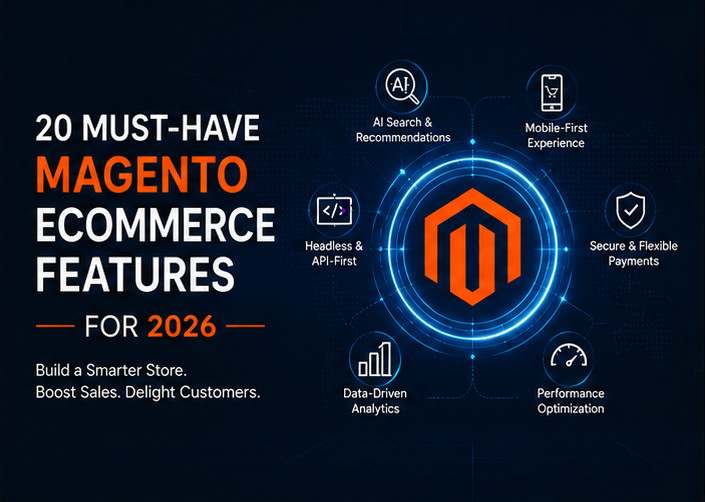
The traditional Magento architecture connects the backend and frontend closely. Modern ecommerce businesses increasingly want more flexibility.
With a headless architecture, Magento can act as the commerce engine while the frontend is developed independently using modern technologies.
Headless Magento Can Support
- Progressive Web Apps
- Mobile applications
- Custom storefronts
- B2B portals
- Marketplace interfaces
- AI shopping experiences
- Multiple digital channels
Magento's GraphQL and API capabilities make it possible to expose commerce functionality to different applications.
However, headless should be adopted because it solves a business requirement, not simply because it is a popular technology.
5. Mobile-First Shopping Experience
Mobile commerce is no longer a secondary experience. For many stores, mobile devices represent a major share of traffic and sales.
Your Magento store should provide an experience that feels fast and intuitive on smartphones.
Important Mobile Features
- Fast page loading
- Mobile-friendly navigation
- Sticky add-to-cart buttons
- Easy product filtering
- Mobile wallets
- Express checkout
- Address autocomplete
- Persistent shopping carts
Responsive design is the minimum standard. Mobile-first conversion optimization is the real goal.
6. One-Page and Express Checkout
Checkout is one of the most important areas for ecommerce conversion optimization.
Customers do not want to complete unnecessary forms or navigate through multiple confusing pages before paying.
A Modern Magento Checkout Should Offer
- Guest checkout
- Express payment buttons
- Apple Pay and Google Pay where supported
- Saved addresses
- Saved payment methods
- Clear shipping options
- Transparent taxes and charges
- Coupon support
- Mobile optimization
Every unnecessary checkout field creates another opportunity for abandonment.
7. Multiple Payment Methods
Payment preferences vary by country, customer, device, and demographic. A Magento store should therefore avoid depending on a single payment option.
Consider Supporting
- Credit and debit cards
- PayPal
- Apple Pay
- Google Pay
- Bank transfers
- Buy Now, Pay Later options
- Digital wallets
- Local payment methods
- Cash on Delivery where appropriate
For larger ecommerce businesses, payment orchestration can also route transactions through appropriate payment providers based on location, currency, payment method, or processor availability.
8. Privacy-Conscious Personalization
Personalization can improve conversion, but modern ecommerce businesses must also take customer privacy seriously.
Magento stores can personalize experiences using useful signals such as:
- Recently viewed products
- Purchase history
- Customer segments
- Product interests
- Geographic availability
- Customer-specific pricing
The key principle is simple:
More relevance, less unnecessary data collection.
9. Strong Magento Security
Security is not a feature that should be considered only after a security incident. It should be part of the Magento architecture from the beginning.
Important Security Measures
- HTTPS
- Two-factor authentication
- Role-based admin permissions
- Secure API authentication
- Web application firewall
- Rate limiting
- Security patches
- Secure backups
- Audit logs
- Restricted server access
Keeping Magento, PHP, extensions, libraries, and server software updated is an essential part of ecommerce security.
10. API and GraphQL Security
As Magento stores become more API-driven, APIs become an increasingly important part of the security boundary.
Every API should be evaluated for:
- Authentication
- Authorization
- Input validation
- Rate limiting
- Token management
- Permission scopes
- Sensitive data exposure
- Abuse detection
API security should receive the same attention as storefront security.
11. Advanced Inventory Management
A simple "In Stock" label is often insufficient for modern ecommerce.
Customers increasingly want to know whether a product is available at a particular location and when it can be delivered.
Useful Inventory Capabilities
- Multi-source inventory
- Warehouse-level stock
- Low-stock notifications
- Backorders
- Preorders
- Safety stock
- Inventory reservations
- Regional availability
- Inventory forecasting
Showing accurate availability can improve customer confidence and reduce order cancellations.
12. Real-Time Shipping Information
Unexpected shipping charges and unclear delivery dates are common reasons for cart abandonment.
A modern Magento store should provide transparent shipping information before the customer reaches the final payment step.
Shipping Calculations Can Consider
- Customer location
- Product weight
- Product dimensions
- Warehouse location
- Delivery service
- Order value
- Customer group
- Delivery speed
Customers should know what they will pay and approximately when they will receive their order.
13. Advanced B2B Ecommerce Features
If your Magento store serves business customers, standard B2C functionality may not be enough.
Important B2B Capabilities
- Company accounts
- Multiple buyers
- Approval workflows
- Shared catalogs
- Contract pricing
- Customer-specific pricing
- Quick order
- Purchase orders
- Quote management
- Credit limits
- Bulk ordering
B2B customers value speed, control, pricing accuracy, and purchasing efficiency.
14. Subscription and Recurring Commerce
Subscription commerce can help businesses create predictable recurring revenue.
This model is particularly useful for products purchased repeatedly, such as consumables, cosmetics, food, pet products, supplements, and business supplies.
Subscription Features
- Recurring billing
- Flexible schedules
- Pause and resume
- Change product or quantity
- Automatic renewal
- Failed payment recovery
- Customer self-service
- Renewal notifications
A strong subscription implementation must correctly handle payment failures, cancellations, refunds, inventory, taxes, and recurring orders.
15. Customer Self-Service Portal
Customers should not have to contact support for every routine request.
A Powerful Customer Account Area Can Include
- Order tracking
- Invoice downloads
- Returns
- Refund status
- Address management
- Saved payment methods
- Wishlist
- Reorder functionality
- Subscription management
- Support requests
- Product reviews
Better self-service reduces support workload while improving customer satisfaction.
16. Automated Returns and RMA
Returns are part of the customer experience. A confusing return process can damage trust even when the original purchase experience was excellent.
A Modern RMA Workflow Can Allow Customers To:
- Select the order.
- Select the product.
- Choose a return reason.
- Upload supporting information if required.
- Select a preferred resolution.
- Receive return instructions.
- Track the return.
- Receive refund or replacement updates.
The RMA system should also connect with customer service, inventory, warehouse, and accounting processes.
17. Advanced Ecommerce Analytics
Analytics should tell you more than how many people visited your website.
Your Magento analytics strategy should measure the complete customer journey.
Important Ecommerce Events
- Product views
- Searches
- Search refinements
- Add-to-cart
- Remove-from-cart
- Checkout initiation
- Payment failures
- Coupon usage
- Purchases
- Returns
- Repeat purchases
For example, if customers search for products but rarely open product pages, the problem could be search relevance. If customers add products to the cart but abandon at payment, the problem could be payment friction.
Good analytics should help answer not only what happened, but why it happened.
18. Magento Performance Optimization
Performance directly affects user experience and can influence ecommerce conversions.
Important Performance Technologies
- Full-page caching
- CDN
- Redis
- Varnish where appropriate
- Image optimization
- WebP and AVIF images
- Lazy loading
- JavaScript optimization
- CSS optimization
- Database optimization
- Efficient indexing
- Background processing
Performance should also be monitored continuously. A website that performs well before launch can become slow after thousands of products, orders, customers, extensions, and integrations are added.
19. AI-Ready Product Data
This is one of the most overlooked Magento features for 2026.
AI search, recommendation systems, shopping assistants, marketplaces, and future AI agents all depend on accurate and structured product information.
Your Product Catalog Should Include
- Clear product names
- Structured attributes
- Detailed specifications
- Dimensions
- Materials
- Compatibility information
- SKU
- Brand
- GTIN where applicable
- Inventory status
- Pricing
- High-quality images
- Videos
- FAQs
AI cannot reliably fix poor product data.
The better your catalog structure, the better your search, recommendations, AI assistant, marketplace feeds, and automated commerce experiences can become.
20. Omnichannel and Agent-Ready Commerce
Customers increasingly interact with brands through multiple channels.
They may discover a product on social media, research it on the website, purchase it through an application, and later contact customer support.
Magento should therefore work as a central commerce engine connecting different customer touchpoints.
A Modern Commerce Ecosystem Can Connect
- Magento website
- Mobile application
- Marketplaces
- Physical stores
- Social commerce
- CRM
- ERP
- Warehouse systems
- Shipping platforms
- Customer support systems
- AI shopping assistants
Prepare for Agentic Commerce
One of the most interesting developments in ecommerce is the growth of AI agents that can search, compare, and potentially complete tasks on behalf of customers.
For example, a customer could eventually ask an AI assistant:
"Find a compatible replacement filter under ₹2,000 and order it."
For this type of commerce to work reliably, your Magento store needs accurate product data, secure APIs, real-time inventory, reliable pricing, shipping information, and robust transaction validation.
Your ecommerce website therefore needs to be both human-readable and machine-readable.
Which Magento Features Should You Prioritize?
You do not necessarily need all 20 features immediately.
The right priorities depend on your business model, customer base, catalog size, traffic, budget, and growth strategy.
For a Small B2C Magento Store
- Fast mobile experience
- Better search
- Express checkout
- Multiple payment methods
- Security
- SEO
- Product recommendations
For a Growing Ecommerce Business
- AI search
- Personalization
- Advanced analytics
- Inventory management
- Marketing automation
- Customer self-service
- Returns management
For Enterprise and B2B Magento Stores
- Headless commerce
- GraphQL/API integrations
- B2B workflows
- ERP integration
- Advanced inventory
- Customer-specific pricing
- AI commerce
- Omnichannel commerce
- Advanced security
- Automated marketing
Final Thoughts
Magento ecommerce in 2026 is moving toward intelligent, personalized, API-driven, secure, and highly automated commerce.
AI-powered search can help customers find products faster. Recommendation engines can increase product relevance. Express checkout can reduce friction. Better inventory and shipping systems can improve transparency. Stronger security can protect increasingly connected commerce environments. Structured product data can prepare stores for AI-assisted shopping and emerging agentic commerce.
But adding technology simply because it is new is not a successful ecommerce strategy.
The best Magento website is not the one with the longest feature list. It is the one that removes the most friction from the customer journey.
Before adding a new feature, ask:
Does this help customers find products faster?
Does it make checkout easier?
Does it increase trust?
Does it improve personalization?
Does it reduce operational costs?
Does it create a better path from product discovery to purchase?
If the answer is yes, that feature deserves serious consideration for your Magento ecommerce website in 2026.
Build a Smarter Magento Store for 2026
The next generation of ecommerce will not be defined only by attractive storefronts. It will be defined by speed, intelligence, personalization, automation, security, and seamless customer experiences.
Whether you are launching a new Magento store or upgrading an existing one, focusing on the right technologies today can help create an ecommerce platform that is ready for the demands of tomorrow.