

Top 5 Ecommerce CMS Platforms: Features, Benefits & Limitations
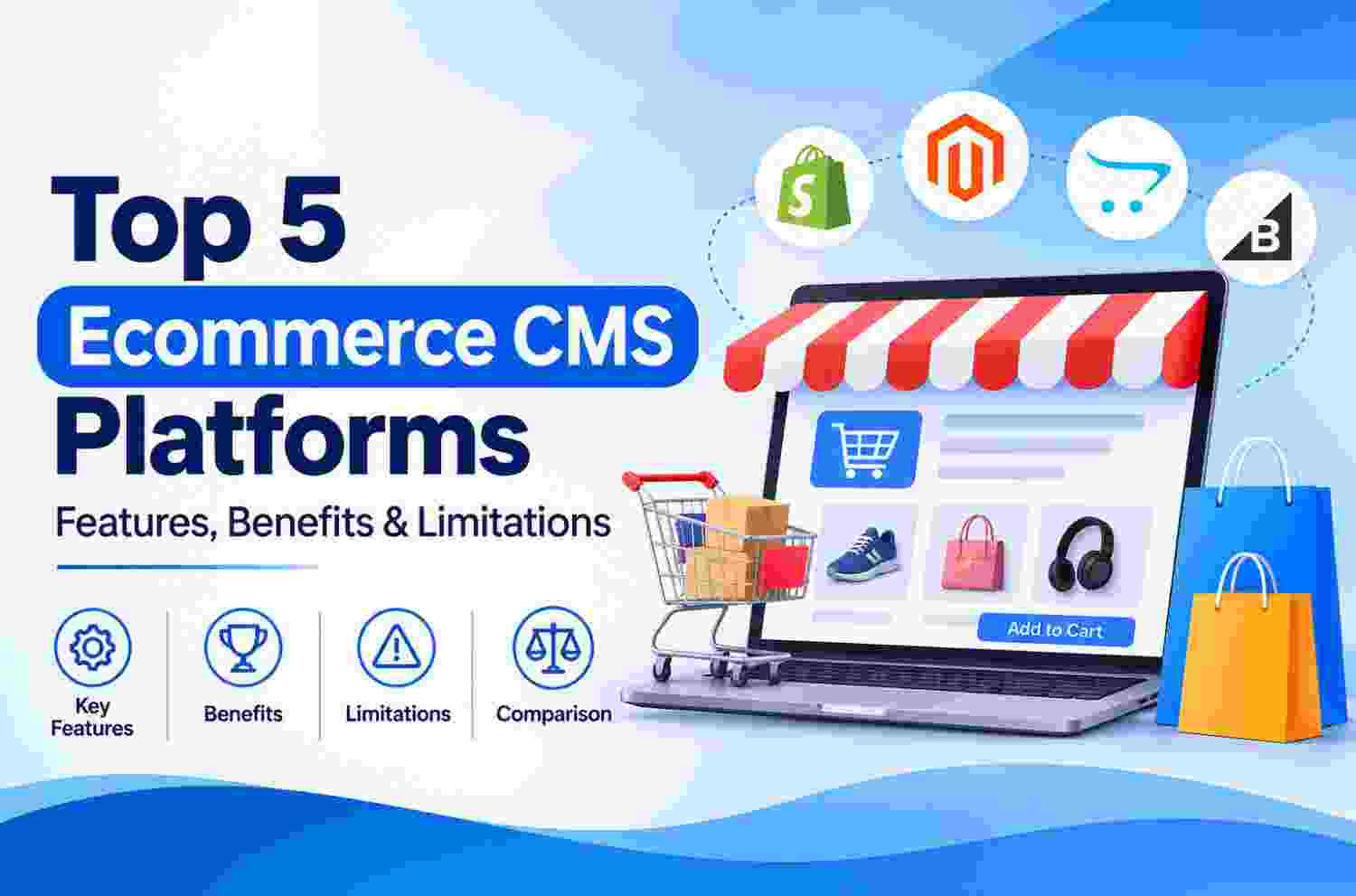
Top 5 Ecommerce CMS Platforms: Key Features, Benefits and Limitations
An ecommerce CMS (Content Management System) helps businesses create, manage, and operate online stores without developing every feature from scratch. It provides tools to manage products, categories, customers, orders, payments, shipping, website content, and other important ecommerce activities.
Choosing the right ecommerce CMS is important for businesses planning to launch an online store, expand their product range, or build a multi-vendor marketplace. Different platforms offer different levels of flexibility, customization, scalability, and ease of management.
In this blog, we will explore the top 5 ecommerce CMS platforms, their key features, major benefits, and limitations to help businesses select the right solution.
1. Shopify – Best for Quick and Easy Ecommerce Store Development
Shopify is one of the most popular hosted ecommerce platforms. It allows businesses to create and manage online stores without handling server configuration, hosting, or complex technical development.
Key Features of Shopify
- Easy-to-use store builder with ready-made themes and templates.
- Product, category, inventory, and order management.
- Integrated payment processing and third-party payment gateway support.
- Discount coupons, promotions, and abandoned checkout recovery.
- SEO tools and blogging functionality.
- Mobile-friendly storefronts and responsive designs.
- Integration with social media and multiple sales channels.
- App marketplace for extending store functionality.
Benefits of Shopify
- Quick store setup with minimal technical knowledge.
- Hosting, security, and platform maintenance are managed.
- Suitable for businesses that want to launch quickly.
- Multiple integrations are available for marketing, shipping, and payments.
- Easy store management through a centralized dashboard.
Limitations of Shopify
- Monthly subscription charges apply.
- Additional transaction fees may apply depending on the payment provider and subscription plan.
- Advanced customization can require developers and higher-tier plans.
- Some advanced features require paid third-party applications.
- Businesses have less control over the underlying hosting infrastructure and platform code.
Who Should Choose Shopify?
Shopify is a good option for businesses that want a professionally managed ecommerce platform with quick deployment, simple administration, and less technical maintenance.

2. WooCommerce – Best for WordPress-Based Ecommerce Development
WooCommerce is an open-source ecommerce plugin built for WordPress. It converts a standard WordPress website into a fully functional online store.
It is particularly popular among businesses that want to combine ecommerce functionality with content marketing, blogging, and SEO.
Key Features of WooCommerce
- Product and category management.
- Physical, digital, variable, and subscription-based products through suitable extensions.
- Order, customer, and inventory management.
- Multiple payment gateway integrations.
- Shipping methods, tax configuration, and delivery options.
- Coupons, discounts, and promotional campaigns.
- Large collection of WordPress themes and plugins.
- Integration with CRM, ERP, email marketing, and other business tools.
- SEO-friendly content management through WordPress.
Benefits of WooCommerce
- The core WooCommerce plugin is available without a monthly platform subscription.
- High flexibility for design and functionality customization.
- Excellent content management and blogging capabilities.
- Large developer and extension ecosystem.
- Businesses have control over their website files and hosting.
- Suitable for combining ecommerce and content-based websites.
Limitations of WooCommerce
- Businesses need to arrange their own hosting and website maintenance.
- Too many plugins can affect website performance and compatibility.
- Advanced functionality may require paid plugins or custom development.
- Security, backups, and software updates require regular attention.
- Large stores may require better hosting and performance optimization.
Who Should Choose WooCommerce?
WooCommerce is suitable for businesses already using WordPress or those that want strong content management, SEO flexibility, and control over their ecommerce website.
Discuss Your Next eCommerce Project with Purpletree's Expert Developers.
3. Magento (Adobe Commerce) – Best for Enterprise Ecommerce Development
Magento, now offered through Adobe Commerce and its open-source ecosystem, is a powerful ecommerce development platform designed for businesses with complex requirements.
It provides extensive customization capabilities, advanced catalog management, multiple storefront management, and integrations with enterprise business systems.
Key Features of Magento
- Advanced product and catalog management.
- Multiple websites, stores, and store views from a single installation.
- Advanced pricing, discounts, and promotional rules.
- B2B functionality, including company accounts, shared catalogs, and quotation workflows in Adobe Commerce.
- Multi-currency and international selling capabilities.
- Customer groups and personalized shopping experiences.
- API-based integrations with ERP, CRM, and third-party applications.
- Advanced inventory and order management through supported solutions.
- Extensive customization through modules and custom development.
Benefits of Magento
- Suitable for complex ecommerce business models.
- Highly customizable architecture.
- Supports multiple storefronts and different brands.
- Powerful B2B and B2C ecommerce capabilities.
- Supports integration with enterprise-level business applications.
- Suitable for businesses planning long-term ecommerce expansion.
Limitations of Magento
- Development and maintenance costs can be high.
- Requires experienced Magento developers for advanced customization.
- Hosting and server requirements can be more demanding than simpler platforms.
- Upgrades and extension compatibility require careful planning.
- Development, testing, and deployment can take more time.
Who Should Choose Magento?
Magento is a strong choice for established businesses that need advanced customization, complex product catalogs, multiple stores, B2B capabilities, and integration with enterprise systems. Smaller businesses with limited budgets may find it unnecessarily complex.
4. OpenCart – Best for Flexible and Cost-Effective Ecommerce Development
OpenCart is an open-source ecommerce CMS that allows businesses to build and manage online stores with flexibility and relatively straightforward administration.
It offers essential ecommerce features through its core system and allows businesses to extend functionality using third-party extensions and custom development.
OpenCart is also a suitable foundation for developing specialized ecommerce solutions, including multi-vendor marketplaces, B2B stores, and customized shopping platforms.
Key Features of OpenCart
- Product, category, manufacturer, and inventory management.
- Order and customer management.
- Multi-store functionality to manage multiple storefronts.
- Multiple currencies, languages, and tax configurations.
- Discounts, coupons, and promotional tools.
- Payment gateway and shipping method integrations.
- SEO-friendly URLs and product management.
- Extensions and themes for additional functionality.
- Admin dashboard for managing store operations.
- API support for integrations and custom applications.
Benefits of OpenCart
- Open-source platform with no mandatory monthly platform subscription.
- Relatively simple administration for everyday store operations.
- Cost-effective for businesses starting ecommerce operations.
- Flexible customization through extensions and custom development.
- Supports multiple stores and different ecommerce business requirements.
- Suitable for building specialized solutions such as multi-vendor marketplaces.
- Businesses can choose their hosting provider and maintain control over their website.
Limitations of OpenCart
- Advanced functionality may require additional extensions or custom development.
- Extension compatibility must be checked against the OpenCart version.
- Complex business workflows may require experienced developers.
- Performance optimization and security updates require regular maintenance.
- Some advanced enterprise features are not available in the default installation.
Who Should Choose OpenCart?
OpenCart is a practical option for businesses looking for a flexible and cost-effective ecommerce CMS. It is particularly useful when a business wants to start with a standard online store and gradually add advanced features such as multi-vendor functionality, POS integration, mobile applications, or custom business workflows.
5. BigCommerce – Best for Growing and Multi-Channel Ecommerce Businesses
BigCommerce is a hosted ecommerce platform designed to support businesses at different stages of growth. It provides built-in ecommerce functionality, flexible APIs, and integrations with various business applications.
The platform supports traditional ecommerce development as well as headless commerce, allowing businesses to create customized frontend experiences while using BigCommerce for backend ecommerce operations.
Key Features of BigCommerce
- Product catalog and inventory management.
- Built-in payment and shipping integrations.
- Multi-channel selling through different sales channels.
- Multi-storefront management for multiple brands and websites.
- B2B ecommerce capabilities and customer-specific pricing.
- Multi-currency and international selling support.
- SEO tools and marketing integrations.
- API support for custom ecommerce development.
- Headless commerce architecture for customized storefronts.
- Reporting, analytics, and order management.
Benefits of BigCommerce
- Provides many built-in ecommerce features.
- Suitable for businesses managing multiple brands and storefronts.
- Supports B2B and B2C business models.
- Hosting and infrastructure management are included.
- Offers API flexibility for custom integrations.
- Supports international ecommerce operations.
Limitations of BigCommerce
- Monthly subscription costs apply.
- Pricing plans and available features may change as the business grows.
- Advanced customization may require experienced developers.
- Some integrations and applications involve additional costs.
- Headless development requires additional technical expertise.
Who Should Choose BigCommerce?
BigCommerce is suitable for growing businesses that need built-in ecommerce capabilities, multiple storefronts, international selling, and B2B functionality without managing their own hosting infrastructure.

Comparison of the Top 5 Ecommerce CMS Platforms
Choosing an ecommerce CMS depends on business size, technical requirements, customization needs, and available budget. The following table provides a quick comparison.
| Ecommerce CMS | Best For | Customization | Hosting | Technical Complexity |
|---|---|---|---|---|
| Shopify | Startups and retailers | Medium | Included | Low |
| WooCommerce | WordPress-based stores | High | Self-managed | Medium |
| Magento | Enterprise businesses | Very High | Self-managed or managed | High |
| OpenCart | SMEs and customized stores | High | Self-managed or cloud | Low to Medium |
| BigCommerce | Growing and B2B businesses | High | Included | Medium |
Note: These are general comparisons. Actual customization, hosting requirements, and complexity depend on the selected version, integrations, extensions, and development approach.
How to Choose the Right Ecommerce CMS for Your Business?
Selecting the right ecommerce CMS is not just about comparing features. Businesses should evaluate their current requirements and future expansion plans.
1. Understand Your Business Requirements
First, identify the type of ecommerce business you want to develop. A single-vendor online store, B2B ecommerce portal, subscription-based store, and multi-vendor marketplace have different functional requirements.
2. Evaluate Customization Options
Check whether the platform supports the features and business workflows you require. Consider product management, checkout customization, payment integration, shipping rules, and third-party applications.
3. Consider Development and Maintenance Costs
Compare the complete cost of ownership rather than just the initial development cost. Include hosting, subscriptions, extensions, customization, security, upgrades, and ongoing maintenance.
4. Check Scalability and Performance
Your ecommerce platform should support increasing products, customers, orders, website traffic, and business operations without requiring frequent platform changes.
5. Evaluate Integration Capabilities
Check whether the CMS can integrate with your existing CRM, ERP, accounting software, payment gateways, shipping providers, marketing tools, and other business applications.
6. Check Security and Technical Support
Consider security updates, backup options, access controls, payment security, and availability of experienced developers for future support.
Conclusion
Every ecommerce CMS has its own strengths and limitations. Shopify is suitable for businesses looking for quick store development, WooCommerce offers flexibility for WordPress-based websites, Magento supports complex enterprise requirements, OpenCart provides a flexible open-source foundation, and BigCommerce offers built-in features for growing and multi-channel businesses.
There is no single ecommerce CMS that is perfect for every business. The right choice depends on your business model, required functionality, development budget, technical resources, and long-term growth plans.
Before starting ecommerce development, carefully evaluate the available platforms and select one that can support your business requirements today and in the future.
Frequently Asked Questions (FAQs)
1. Which is the best ecommerce CMS for developing an online store?
Shopify, WooCommerce, Magento, OpenCart, and BigCommerce are popular options. The best choice depends on your business requirements, budget, customization needs, and technical resources.
2. Which ecommerce CMS is best for small businesses?
Shopify, WooCommerce, and OpenCart are commonly considered for small businesses. WooCommerce and OpenCart also provide open-source options for businesses that want greater control over their websites.
3. Which ecommerce platform is best for developing a multi-vendor marketplace?
Magento, WooCommerce, and OpenCart can be extended to support multi-vendor marketplace functionality. The right platform depends on vendor management, commission calculation, seller dashboards, payment splitting, and other marketplace requirements.
4. Is an open-source ecommerce CMS better than a hosted platform?
Open-source platforms provide greater control over source code, hosting, and customization. Hosted platforms reduce infrastructure management and simplify maintenance. The better option depends on the business's technical resources and requirements.
5. Can an ecommerce CMS be customized according to business requirements?
Yes. Most ecommerce CMS platforms support customization through extensions, plugins, APIs, themes, and custom development. However, the available flexibility differs between platforms.
6. What should businesses consider before selecting an ecommerce CMS?
Businesses should evaluate functionality, customization, scalability, security, hosting, integrations, development costs, and ongoing maintenance requirements.
- Let's Discuss Your Next eCommerce Project.