

Secure Ecommerce Website from Hackers with These Security Tricks
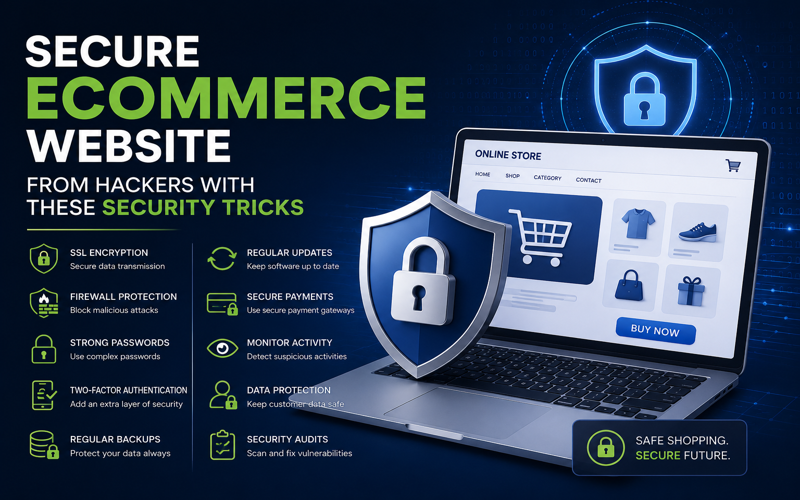
Hackers are always around, peeping through the gaps and holes in your website. They do not leave a single chance to intrude and cause damage. Hence, it would help if you were careful and alert to make their plans unsuccessful.
Your website and your customers should also be protected from intrusion when you run an eCommerce website. You are supposed to offer a safe and secure business connection. Therefore, hire a team of web designers and eCommerce website development services who know how to handle security issues well.
Thieves are always on the hunt for credit card numbers, personal details, bank transaction passwords, and other sensitive information. Hence, give the maximum preference to data security.
Here are some useful tips to protect your website against hacking or intrusion from inside or outside.
Avoid saving unnecessary data.
When you have loads of information, there is always a risk of losing it. Hackers can’t steal something nonexistent. Don’t collect or save any confidential data which is not required for the business. When you process credit card details, use the encrypted tunnel. Make use of your own servers. Checkout time slightly increases in the process, but it is far better than compromising data security.
Use SSL/TSL for encrypting browser communication.
It would be best if you used an encrypted communication channel between your website and browser. Always transmit confidential information through the link. You need to update the SSL and TSL algorithm to the latest version so that there is no vulnerability.
Be careful while choosing a hosting provider.
The web hosting provider must offer you sophisticated tools and applications that will keep your eCommerce site secure. The typical characteristics that determine the quality of a hosting provider are:
- You are offered regular backups.
- Comprehensive logs are maintained for your website.
- The hosting provider monitors the network, traffic regularly.
- In the case of a security breach, you are offered a detailed report.
- There is always SPOC (Single Point of Contact) for your account.
- You are kept informed about the disaster management procedure.
If the hosting provider offers all these things, then you have sufficient reason to relax.
Keep testing the website against vulnerability.
Remember, you should check the security features at regular intervals, just like soldiers who practice daily even when there is no war-like situation. Test the links regularly. Ask the e-commerce development partner to ensure no malware into links, graphics, advertisements, or other third-party content.
Penetration testing is another powerful way of checking website integrity. Hire professional hackers to find out risks. Install security apps so that you can identify the whole range of vulnerabilities. The examples are; Cross-Site Scripting, vulnerabilities in the source code, or other confidential data risks.
Other than these precautions, you can also ensure other security measures such as separating data access points for business partners and customers. Install the right firewall and configure it well so that you can address the issues of network security. Prevention and detection of data loss save from potential threats.
Follow these tips and secure your eCommerce website from unauthorized access or tampering.

Implement Strong Password Policies
Weak passwords are one of the biggest reasons behind unauthorized website access. Every admin panel, hosting account, database, and payment gateway should have strong passwords with a combination of uppercase letters, lowercase letters, numbers, and special characters.
Additionally, enable Two-Factor Authentication (2FA) for admin login areas to add an extra layer of protection. This minimizes the chances of hackers accessing your ecommerce store even if passwords are compromised.
Keep Ecommerce Platform and Plugins Updated
Outdated ecommerce platforms, themes, and plugins often contain security loopholes that hackers can exploit easily. Whether you use OpenCart, Magento, WooCommerce, Shopify, or any other ecommerce platform, regular updates are essential.
Always install the latest security patches and remove unused plugins or extensions from the website. A professional ecommerce development company like Purpletree Software can help maintain your store with proper updates and security monitoring.
Enable Firewall and DDoS Protection
A Web Application Firewall (WAF) helps block suspicious traffic, malware attacks, SQL injections, and brute-force login attempts before they reach your website server.
DDoS protection is equally important for ecommerce businesses because attackers may attempt to overload your server with fake traffic and crash the website. Proper firewall configuration and server-level security can prevent such threats effectively.
Use Secure Payment Gateways
Payment security is one of the most critical parts of an ecommerce website. Always integrate trusted and PCI-DSS compliant payment gateways that offer encrypted payment processing and fraud detection mechanisms.
Avoid storing customers’ payment details directly on your website server. Secure payment gateways help reduce the risk of financial fraud and data theft.
Restrict Admin Access and User Permissions
Not every employee or team member requires complete access to the ecommerce website backend. Role-based access control helps limit sensitive permissions and reduces internal security risks.
Provide only the required access to staff members, developers, content managers, and support teams. Regularly review inactive user accounts and remove unnecessary admin access.
Backup Your Website Regularly
Website backups act as a recovery solution during malware attacks, server crashes, accidental deletion, or ransomware incidents. Automated daily backups ensure that your ecommerce business can quickly restore operations without losing important customer or order data.
Store backups on secure cloud servers or remote locations instead of relying only on local server backups.
Monitor Website Activity Continuously
Real-time monitoring tools help detect suspicious activities, unusual login attempts, malware injections, and unauthorized file changes. Security monitoring enables quick action before the issue becomes critical.
Businesses should also maintain detailed activity logs for better tracking and faster incident investigation.
Secure APIs and Third-Party Integrations
Modern ecommerce websites often use third-party APIs for shipping, payment processing, CRM systems, analytics, and marketing automation. Every third-party integration can potentially create security vulnerabilities if not managed properly.
Use secure API authentication methods, regularly review API permissions, and remove unused integrations to maintain a secure ecommerce ecosystem.
Educate Employees About Cybersecurity
Many cyberattacks happen because of phishing emails, weak passwords, or human errors. Ecommerce businesses should train employees about cybersecurity best practices, suspicious email detection, password management, and secure data handling procedures.
Employee awareness significantly reduces the chances of accidental security breaches.
Why Ecommerce Security Matters for Business Growth
Customers only purchase from ecommerce websites they trust. A secure ecommerce website improves customer confidence, protects business reputation, ensures smooth online transactions, and helps businesses comply with data protection regulations.
Ignoring website security can lead to financial losses, legal issues, reduced customer trust, and negative brand reputation. Therefore, investing in ecommerce security should always be a top priority for every online business.
Conclusion
Securing an ecommerce website is not a one-time process but an ongoing responsibility. Businesses must continuously monitor, update, and improve their security infrastructure to stay protected against evolving cyber threats.
By implementing strong security practices like SSL encryption, secure hosting, firewall protection, regular updates, vulnerability testing, secure payment gateways, and backup systems, you can significantly reduce the risk of cyberattacks and ensure a safe shopping experience for your customers.
If you are planning to build or secure your ecommerce website, professional ecommerce experts at Purpletree Software can help you develop secure, scalable, and performance-driven ecommerce solutions tailored to your business needs.