

How to convert your eCommerce traffic into paying customers
So you have got your E-commerce business up and running and have started getting traffic to your ecommerce website organically or through SEO, SMM, SEM or other marketing initiatives. However, if you are now concerned about not achieving the expected sales and are facing the issue of converting the traffic into an actual customer; you might want to consider the following points.
- Pricing: It’s common knowledge that the Indian consumer is more price conscious than his international counterparts. Most of the Indian consumer will research the products price on multiple websites online before making a purchase. Hence, it’s imperative for ecommerce owners to keep a constant check on competitor pricing and offers. The most obvious way would be to lower the product price (if possible) or offer a better deal. One might also consider the use of smart/dynamic pricing strategies which help in end conversions.
- Better Value Proposition: An ecommerce business that cannot beat its competitor on pricing should look to offer a better value proposition. The Indian consumers are evolving and have started considering the overall value proposition in terms of cost and service quality. They are willing to spend a little more as long as they believe the will get a better and hassle-free service. Some important aspects include:
- Shipping cost & time: If competing on price is out of the question offering a free shipping with a delivery of within a weeks’ time is a must-have for any ecommerce biz to increase conversion. While one might consider charging for a priority deliver its important to making sure that the final price does dilute the value proposition.
- Easy returns: Having an Easy – hassle free return policy inculcates a sense of trust; which intern helps in end conversions, as long as the return policy is exclusively stated during the checkout process.
- Easy checkout: Keeping the checkout process as simple and as few steps as possible will help avoid customers abandoning the checkout process halfway.
- Chat feature: Including a chat feature during the checkout process could help you close a potential patient. It helps understand why the customer is about to abandon his cart and provides an opportunity to address his issue. This also helps understand why customers are not converting. It’s important to keep in mind that the user should be prompted ONLY if he is inactive for more than 30-60 seconds as it is important not to divert customer’s attention while he is entering information.
- Relevant landing pages for your PPC campaigns: This might sound obvious but quite a few ecommerce businesses take their paid customers to the home page, which results in reduces conversions (unless it’s purely a brand-building campaign). It’s important to understand that paid customer is looking for a specific product and would like to be taken directly to the product page, thereby, reducing his search cost and potential for conversion.
We have only scraped the tip of the iceberg here and would give you more insights on these pointers in our upcoming articles.
We at Purpletree believe that we are not just your web-development agency but also partners in your ecommerce business. We are open to assist you in implementing these suggestions and increase your conversions. You may contact us on sales@Purpletreesoftware.com
Understanding the Difference Between Traffic and Conversions
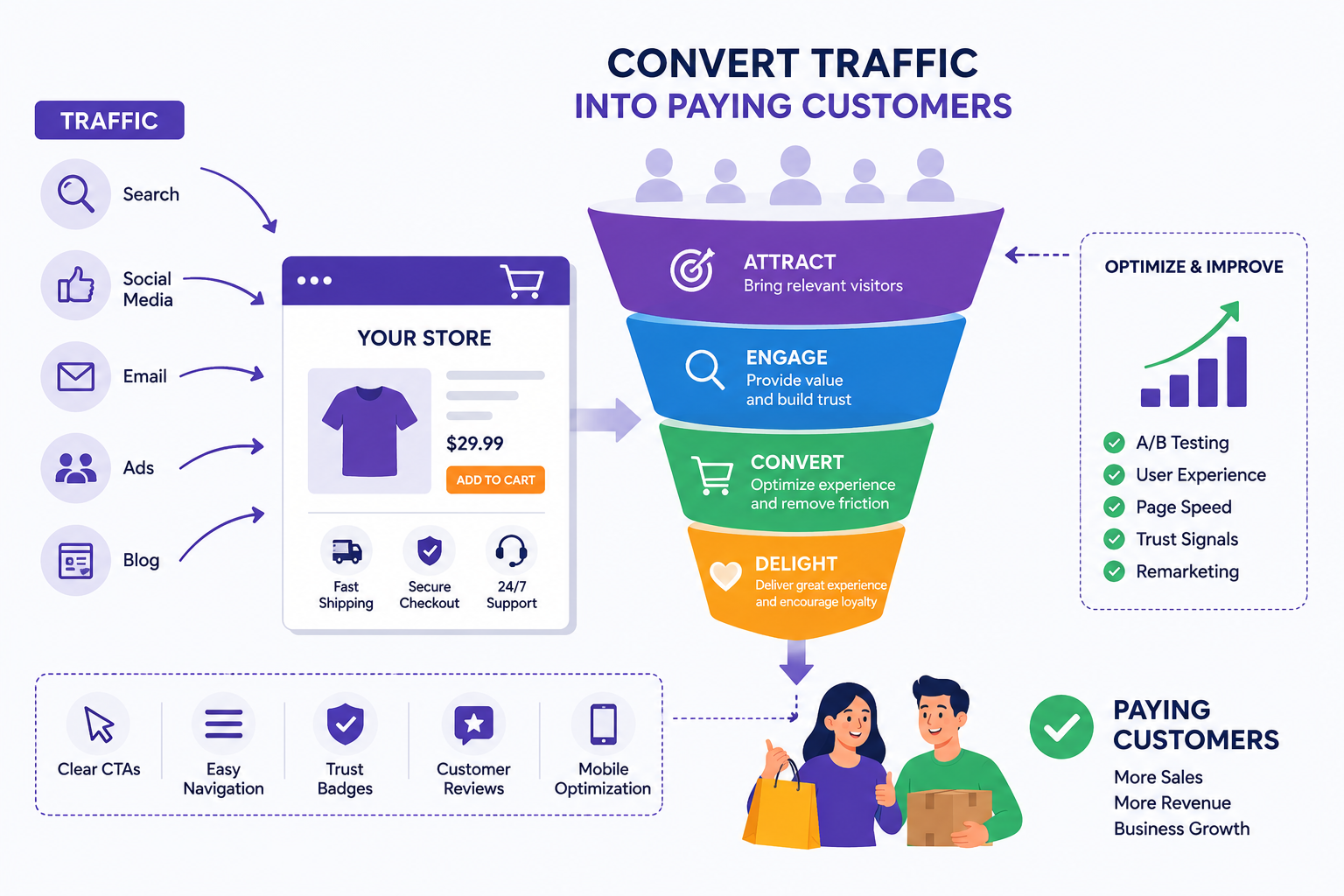
Generating traffic to your eCommerce website is an important achievement, but traffic alone does not guarantee revenue. The real success of an online store depends on its ability to convert visitors into paying customers.
Many businesses invest heavily in SEO, social media marketing, paid advertising, and email campaigns to attract visitors. However, if those visitors do not complete a purchase, the return on investment remains limited.
The key is to optimize every stage of the customer journey and remove barriers that prevent conversions.
Build Trust Before Asking for a Sale
Display Trust Signals
Customers are more likely to purchase from websites they trust.
Important trust elements include:
- SSL security certificates
- Secure payment badges
- Customer reviews
- Testimonials
- Return and refund policies
- Contact information
Trust signals reduce purchase hesitation and improve conversion rates.
Showcase Social Proof
People often rely on the experiences of others before making a buying decision.
Examples include:
- Product ratings
- Customer reviews
- User-generated content
- Success stories
Social proof helps build confidence and credibility.
Optimize Product Pages for Conversions
Use High-Quality Product Images
Product images often influence buying decisions more than product descriptions.
Best practices include:
- Multiple product views
- Zoom functionality
- Lifestyle images
- Mobile-optimized visuals
Write Benefit-Focused Descriptions
Instead of simply listing features, explain how the product solves customer problems or improves their lives.
Focus on:
- Benefits
- Use cases
- Key advantages
- Frequently asked questions
Improve Website Speed and Performance
Faster Websites Convert Better
Slow websites create frustration and increase bounce rates.
A fast-loading store provides:
- Better user experience
- Higher engagement
- Improved search rankings
- More completed purchases
Speed Optimization Techniques
Consider:
- Image compression
- Browser caching
- Content delivery networks
- Optimized hosting
- Code minimization
Simplify the Customer Journey
Reduce Navigation Complexity
Customers should find products quickly and easily.
Helpful features include:
- Clear menus
- Product filters
- Advanced search
- Category organization
Minimize Checkout Steps
A complicated checkout process often leads to abandoned carts.
Best practices include:
- Guest checkout
- Fewer form fields
- Progress indicators
- Auto-fill functionality
Personalization Drives Higher Conversions
Product Recommendations
Personalized recommendations increase average order values and improve shopping experiences.
Examples include:
- Frequently bought together
- Similar products
- Recently viewed products
- Personalized suggestions
Dynamic Content
Showing relevant content based on customer behavior can improve engagement and conversion rates.
Use Strategic Calls-to-Action
Make CTAs Clear and Visible
Every page should guide visitors toward a specific action.
Examples include:
- Add to Cart
- Buy Now
- Get Started
- Request a Quote
CTAs should be prominent and easy to understand.
Create Urgency
Urgency can encourage faster decision-making.
Examples include:
- Limited-time offers
- Low-stock notifications
- Flash sales
- Seasonal promotions
Reduce Shopping Cart Abandonment
Common Causes of Cart Abandonment
Customers often leave without completing purchases because of:
- Unexpected shipping costs
- Complex checkout processes
- Security concerns
- Limited payment options
Recovery Strategies
Recover lost sales through:
- Cart abandonment emails
- Remarketing campaigns
- Special discount offers
- Personalized reminders
Offer Flexible Payment Options
Customers have different payment preferences.
Providing multiple payment methods improves convenience and increases conversion opportunities.
Popular options include:
- Credit cards
- Debit cards
- Digital wallets
- UPI payments
- Net banking
- Buy now, pay later solutions
The easier it is to pay, the more likely customers are to complete purchases.
Leverage Live Chat and Customer Support
Real-Time Assistance
Visitors often have questions before purchasing.
Live chat helps:
- Address concerns immediately
- Improve customer confidence
- Reduce abandonment rates
- Increase sales opportunities
AI-Powered Support
Modern chatbots can provide instant responses while reducing support workload.
Mobile Optimization Is Essential
Mobile Commerce Growth
A significant percentage of eCommerce transactions now occur on mobile devices.
Your store should provide:
- Responsive design
- Fast mobile loading
- Easy navigation
- Mobile-friendly checkout
Consistent Multi-Device Experience
Customers frequently switch between devices before making a purchase. A seamless experience across all devices helps improve conversion rates.
Use Analytics to Improve Performance
Monitor Key Metrics
Track important indicators such as:
- Conversion rate
- Bounce rate
- Cart abandonment rate
- Average order value
- Customer acquisition cost
Test and Optimize
Continuous testing helps identify opportunities for improvement.
Popular methods include:
- A/B testing
- Heatmap analysis
- User behavior tracking
- Conversion funnel analysis
Retarget Visitors Who Leave
Most visitors do not purchase during their first visit.
Remarketing Campaigns
Remarketing helps re-engage potential customers through:
- Display advertisements
- Social media campaigns
- Email marketing
- Personalized offers
Email Nurturing
Targeted email sequences can guide prospects through the purchasing process and increase conversions.
Building Long-Term Customer Relationships
Loyalty Programs
Reward programs encourage repeat purchases and increase customer lifetime value.
Personalized Communication
Regular communication through email and promotions helps maintain customer engagement and strengthen relationships.
Future Trends in eCommerce Conversion Optimization
Artificial Intelligence
AI helps businesses deliver:
- Personalized shopping experiences
- Predictive recommendations
- Dynamic pricing strategies
Voice Commerce
Voice-enabled shopping is creating new opportunities for customer engagement and conversions.
Omnichannel Experiences
Customers increasingly expect consistent experiences across websites, mobile apps, marketplaces, and social commerce platforms.
Frequently Asked Questions
Why is my eCommerce website getting traffic but not sales?
Common reasons include poor user experience, slow loading speeds, weak trust signals, complicated checkout processes, or mismatched traffic sources.
What is a good eCommerce conversion rate?
Conversion rates vary by industry, but improving customer experience and reducing friction can significantly increase results.
Does website speed affect conversions?
Yes. Faster websites generally produce higher engagement, lower bounce rates, and better conversion rates.
How can I reduce cart abandonment?
Simplify checkout, provide transparent pricing, offer multiple payment methods, and use cart recovery campaigns.
Conclusion
Converting eCommerce traffic into paying customers requires more than attracting visitors. Businesses must focus on trust, usability, personalization, checkout optimization, mobile performance, and continuous testing. By improving every stage of the customer journey, online stores can increase conversions, maximize marketing investments, and build sustainable long-term growth.