

Why should you integrate ERP with your ecommerce store
E-commerce has simply revolutionized the idea of selling a number of products giving several benefits to the users. However, not many e-retailers realize the importance of integrating the ERP with the e-commerce portal. Generally, one can find the e-commerce venture owners using the two (online store & ERP) separately. Hence they simply end up losing the benefits one can reap integrating the two together. Just imagine if you are able to integrate the two without any kind of human interaction, you end up reaping loads of benefits; let’s check few advantages as under:
Boost up the self-service feature
The availability of the real-time data from the ERP over the online store will help the consumers to have a view of the inventory, the current order status, shipment tracking with specific tracking numbers, etc. This will allow the e-retailers in reducing the operation cost and thus enhances the customer experiences within your front end of your store.
Inventory Cost Reduction via Sales Data Updates
All the web portal based sales data will quickly be visible over the ERP system. The ERP item inventory will also be updated as per the web transactions. Hence with the updated data pertaining to web sales and inventory, the ERP user can easily plan the purchase of a number of products and hence reduce the cost of inventory.
Generate financial reports ERP as per Web Transactions
The e-come applications are able to create several financial reports pertaining to sales. However, with the ERP integration e-retailer gets the capability to prepare a number of statements like Balance Sheet, Trial Balance, P/L Statement, Cash Flow, Trial Balance, etc. that offers transparency in financial data all across the business organization.
Get higher internal productivity
As the integrated system simply streamlines a number of business processes, this has decreased the involvement of human resources. The web sales orders will be clubbed to ERP system in real time, which help the back office ERP users to track the orders instantly and take the further step. In this way, the order fulfillment cycle is reduced via this integration.
Minimal Human Involvement, Error and Data Redundancy
With the integration of ERP and Shopping portal, the online consumer’s data, the online orders, payment and shipping details can be easily integrated into the ERP system. In this way, the data of inventory and item can be uploaded via the ERP to the online store. Consequently, this will reduce the need for re-entering the data. The online merchant witnesses a good amount of human involvement along with reducing issues like data redundancy and human errors over both the platforms.
Better customer satisfaction & control over your business
With this integration, there is an ease of getting a majority of date product data, availability details of inventory, tracking details of orders, etc over the portal through the ERP development system. This helps in increasing the customer satisfaction to a great level and also reduces the operations issues of e-commerce business. Secondly, the e-retailers are able to find a better control over their businesses, which in turn give them a competitive edge.
Understanding ERP Integration in eCommerce
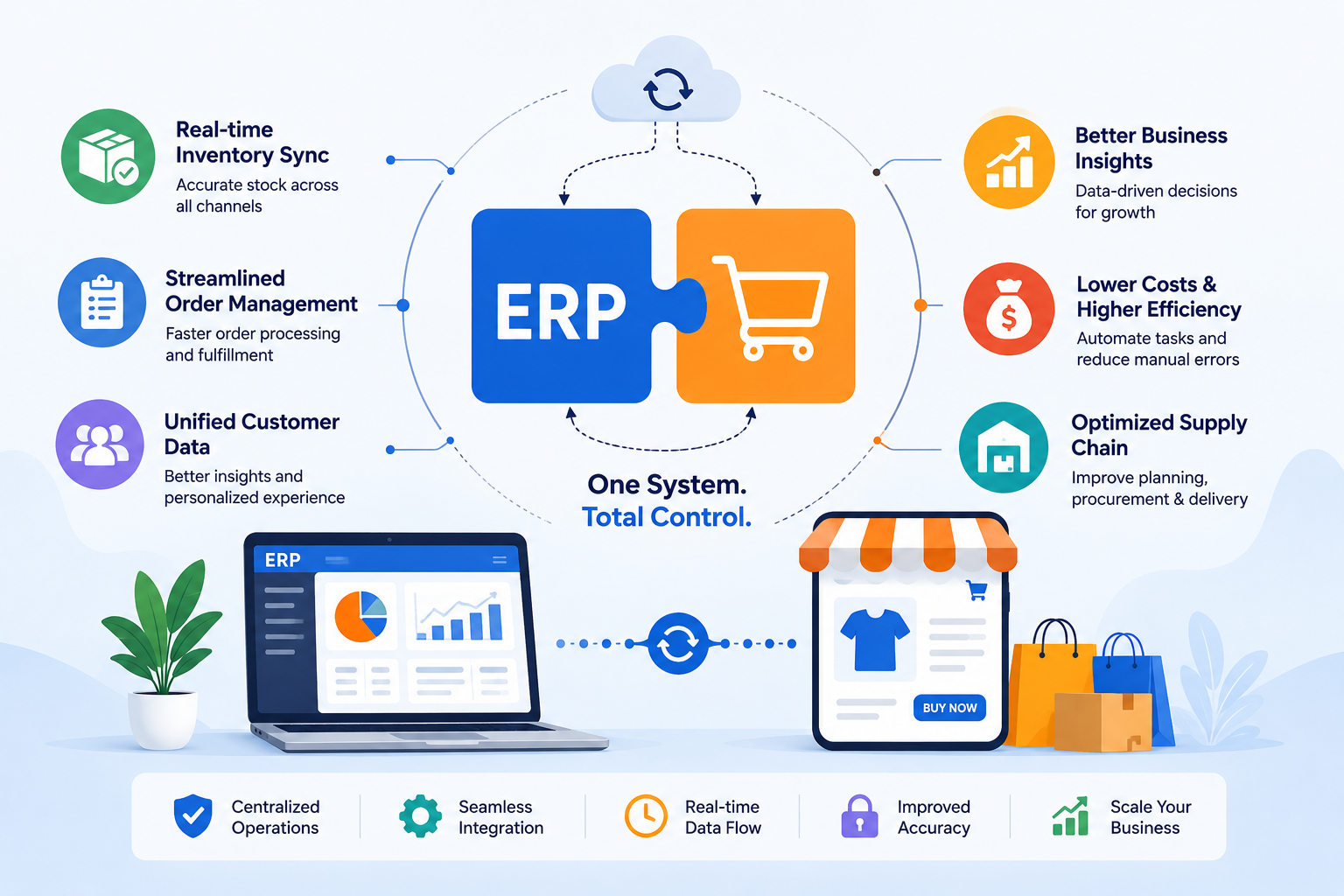
Enterprise Resource Planning (ERP) systems help businesses manage critical operations such as inventory, finance, purchasing, customer management, logistics, and reporting from a centralized platform. When integrated with an eCommerce store, ERP becomes a powerful tool that synchronizes business data in real time and eliminates manual processes.
As online businesses grow, managing data separately across multiple systems becomes increasingly difficult. ERP integration helps create a seamless connection between front-end sales channels and back-office operations.
Key Benefits of ERP Integration
Centralized Business Management
An integrated ERP system provides a single source of truth for your business data.
Benefits include:
- Unified inventory management
- Centralized customer information
- Real-time order tracking
- Consistent financial reporting
- Better business visibility
This eliminates confusion caused by disconnected systems and duplicate data entries.
Real-Time Data Synchronization
One of the biggest advantages of ERP integration is automatic data synchronization.
Data updated in one system is instantly reflected across connected platforms, including:
- Product inventory
- Customer accounts
- Orders
- Shipping information
- Financial records
This ensures greater accuracy and operational efficiency.
Inventory Management Made Smarter
Real-Time Stock Visibility
Inventory inaccuracies can lead to overselling, stock shortages, and customer dissatisfaction.
ERP integration enables:
- Automatic inventory updates
- Accurate stock levels
- Warehouse synchronization
- Inventory forecasting
This helps businesses maintain optimal inventory levels while reducing carrying costs.
Improved Purchasing Decisions
With real-time sales and inventory data, businesses can make informed purchasing decisions and avoid overstocking or understocking products.
Streamlined Order Processing
Automated Order Management
ERP integration automates many order-related tasks, including:
- Order creation
- Inventory allocation
- Invoice generation
- Shipping coordination
This significantly reduces manual workload and processing delays.
Faster Order Fulfillment
Automated workflows help businesses process and fulfill orders more quickly, leading to:
- Shorter delivery times
- Better customer satisfaction
- Reduced operational costs
Enhanced Customer Experience
Self-Service Capabilities
Modern customers expect instant access to information.
ERP integration allows customers to view:
- Product availability
- Order status
- Shipment tracking
- Purchase history
This reduces support requests and improves customer satisfaction.
Better Communication
Accurate and up-to-date information helps businesses provide faster and more reliable customer service.
Financial Management and Reporting
Automated Financial Data Flow
ERP systems help businesses manage financial operations more efficiently by integrating sales data directly into accounting processes.
Benefits include:
- Automated invoicing
- Revenue tracking
- Tax management
- Expense monitoring
Comprehensive Reporting
Integrated ERP systems provide access to important reports such as:
- Profit and loss statements
- Balance sheets
- Cash flow reports
- Sales performance reports
These reports support strategic decision-making and business planning.
Reducing Human Errors and Data Redundancy
Eliminate Manual Data Entry
Without integration, employees often need to enter the same information into multiple systems.
ERP integration removes this duplication by automating data transfers between platforms.
Improve Data Accuracy
Reducing manual intervention minimizes:
- Typing mistakes
- Inventory discrepancies
- Duplicate records
- Order processing errors
This improves overall business reliability.
Improved Operational Productivity
Workflow Automation
ERP integration automates repetitive tasks and allows teams to focus on higher-value activities.
Examples include:
- Inventory synchronization
- Purchase order generation
- Customer notifications
- Financial updates
Better Resource Utilization
Employees spend less time on administrative work and more time on customer service, marketing, and business growth initiatives.
Multi-Channel Commerce Management
Many businesses sell through multiple channels, including:
- Online stores
- Marketplaces
- Mobile applications
- Physical retail locations
ERP integration helps synchronize information across all channels, ensuring consistency and accuracy.
Unified Inventory Across Channels
Businesses can manage inventory centrally while preventing stock conflicts between sales channels.
Better Order Visibility
Administrators gain complete visibility into all orders regardless of their source.
Scalability for Growing Businesses
As eCommerce businesses expand, operational complexity increases.
ERP integration supports growth by:
- Managing larger inventories
- Processing higher order volumes
- Supporting multiple warehouses
- Handling international operations
This allows businesses to scale efficiently without significantly increasing administrative overhead.
ERP Integration and Business Intelligence
Data-Driven Decision Making
Integrated ERP systems provide valuable insights into:
- Customer behavior
- Product performance
- Inventory trends
- Revenue growth
Strategic Planning
Business leaders can use this information to:
- Optimize operations
- Improve forecasting
- Increase profitability
- Identify growth opportunities
Future Trends in ERP and eCommerce Integration
Artificial Intelligence
AI-powered ERP systems are helping businesses automate forecasting, inventory planning, and customer service functions.
Cloud ERP Solutions
Cloud-based ERP platforms offer greater flexibility, scalability, and accessibility for modern businesses.
Advanced Automation
Future ERP systems will continue reducing manual intervention through intelligent process automation.
Real-Time Analytics
Businesses increasingly rely on live dashboards and analytics to monitor performance and make faster decisions.
Frequently Asked Questions
What is ERP integration in eCommerce?
ERP integration connects your online store with business management systems, allowing data such as orders, inventory, customers, and financial records to synchronize automatically.
Why is ERP integration important?
ERP integration improves efficiency, reduces errors, automates processes, and provides better visibility into business operations.
Does ERP integration improve inventory management?
Yes. ERP integration provides real-time inventory updates and helps businesses maintain accurate stock levels across all sales channels.
Can ERP integration improve customer satisfaction?
Absolutely. Customers benefit from accurate inventory information, order tracking, faster fulfillment, and improved support experiences.
Conclusion
ERP integration is one of the most valuable investments an eCommerce business can make. By connecting inventory management, order processing, financial reporting, customer information, and logistics into a unified system, businesses can improve efficiency, reduce costs, enhance customer satisfaction, and support long-term growth. As eCommerce operations become more complex, ERP integration provides the visibility, automation, and control necessary to remain competitive in today's digital marketplace.