

Role of Shipping and Fulfillment Integration for success of eCommerce business
Thursday, 16 October 2014 | Written by Purpletree |
According to LocalBanya, 98% order fulfillment along with well-trained customer service makes people to come back to its site for fulfilling their grocery and household needs. This fact itself says about the significance of having an ecommerce order and fulfillment process that is no less than the backbone of any online store when it comes to ecommerce website development India.
Online order and shipping influences almost everything, including loyalty and conversions. Therefore, if they are not efficient, the ecommerce business is likely to lose both sales and customers. Well, it is common sense to comprehend that customers want their packages shipped swiftly at least possible cost.
However, meeting this basic customer expectation becomes tough in case of manually transcribing the order information between the ERP and e-commerce systems, which involves high risk of errors and much consumption of time. For eliminating these issues, an integrated system for shipping and order fulfillment is an ideal solution, as it improves efficiency and productivity by automatically reflecting the information in one system in the other.
For any ecommerce development company, it is critically vital to be quick and accurate when it comes to responding to a customer visiting or buying from the online store. Moreover, the complete shopping experience has to be flawless so that a customer can effortlessly and reliably track an order via the fulfillment process.
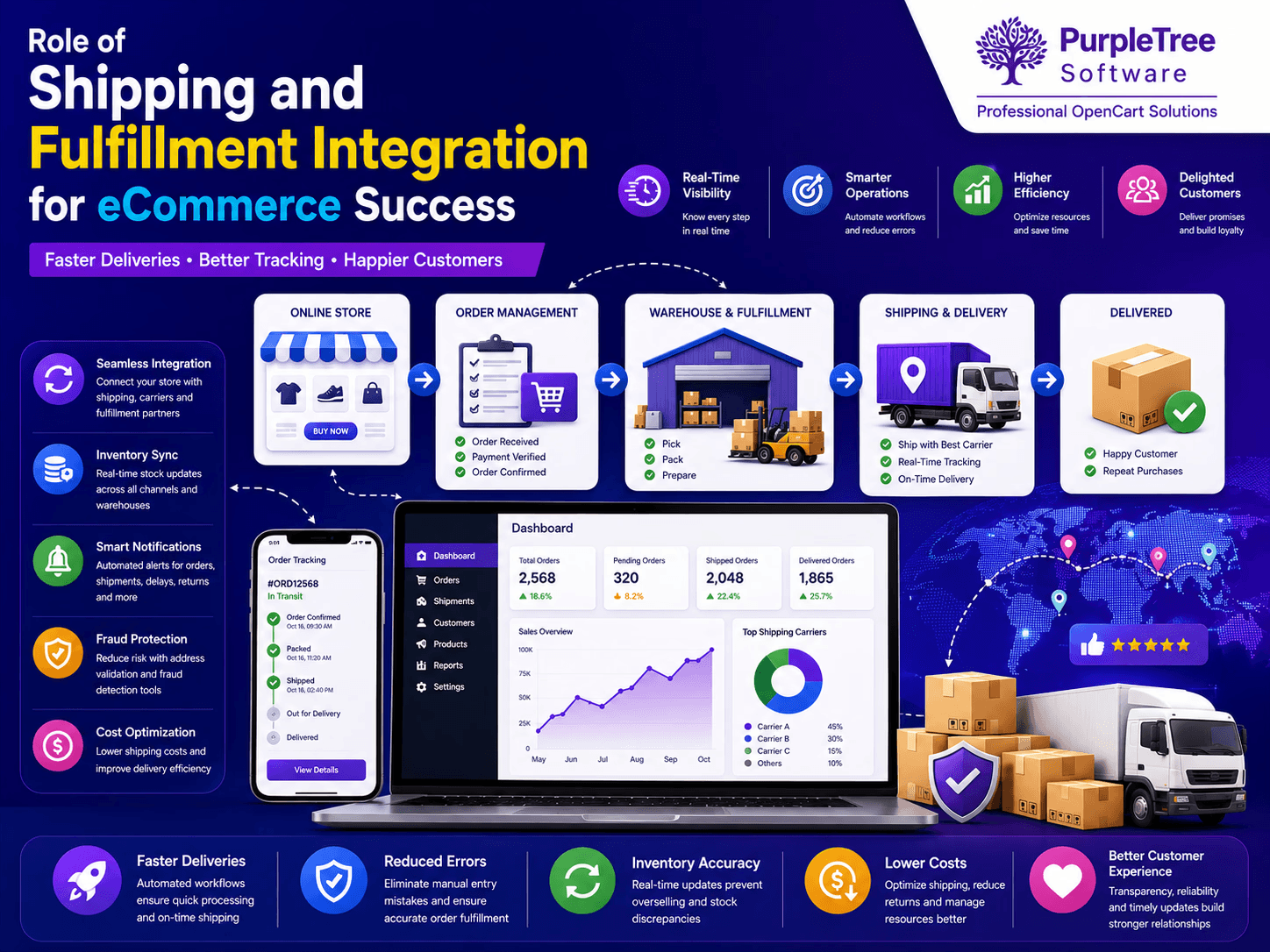
Currently, this is best done through integration, as it ensures customer-oriented functionality and seamless efficiency, allowing management of an increasing number of orders in least time and with fewer issues. Such a smart, real-time integration has the following roles to play:
Timely, Precise Informer
When the online shopping portal works with an integrated system for fulfilling orders and shipping choices, it informs the retailer about the full process, right from starting to the end. As a result, the retailer is in the position to easily provide up-to-date information and answer different questions from the customers, in case they call for getting additional information. Moreover, by offering real-time updates through automated order or shipping confirmations, even the customer is kept informed, which is a good indicator of quality service.
Comprehensive Tracking Facilitator
Once the shopping cart gets integrated with order fulfillment, the retailer becomes capable of keeping a full track of orders in bulk, instead of micro managing each order. Moreover, because the order and shipping management is automated, it becomes easy to measure exactly where orders stand at any point in time.
Issue Determinator
It is truly disagreeable for an online retailer to have a high rate of shopping cart abandonment. However, with a perfect integration of order fulfillment, the retailer can easily determine the level of such abandonment as well as find out how to convert them into loyal conversions by giving them their demanded shipping and order options. In most cases, the lack of desired shipping options result in abandonment.
Cost Controller
Why Shipping and Fulfillment Matter in Modern eCommerce
In today's highly competitive ecommerce environment, product quality alone is not enough to retain customers. Buyers expect fast deliveries, accurate order processing, real-time tracking, and transparent communication throughout the purchasing journey.
Shipping and fulfillment operations directly influence customer satisfaction, repeat purchases, and brand reputation. Businesses that streamline these processes often gain a significant competitive advantage in the marketplace.
Benefits of Automated Shipping Integration
Integrating ecommerce platforms with shipping and fulfillment systems eliminates many manual tasks and improves operational efficiency.
Faster Order Processing
Automation reduces the time required to transfer order information between systems, allowing businesses to process and dispatch orders more quickly.
Improved Accuracy
Manual data entry can lead to shipping errors, incorrect addresses, and delayed deliveries. Integrated systems minimize human intervention and reduce costly mistakes.
Real-Time Synchronization
Order statuses, inventory levels, and shipment details are updated automatically across all connected platforms, ensuring accurate information for both merchants and customers.
Enhanced Customer Experience Through Visibility
Modern consumers want complete visibility into their orders.
Real-Time Order Tracking
Customers appreciate being able to track shipments from dispatch to delivery without contacting customer support.
Automated Notifications
Integrated fulfillment systems can automatically send:
- Order confirmations
- Shipping notifications
- Delivery updates
- Return and refund status updates
This transparency helps build trust and improves the overall shopping experience.
Faster Customer Support
Customer service teams can instantly access shipment information, reducing response times and increasing customer satisfaction.
Inventory Management Advantages
Shipping and fulfillment integration plays an important role in inventory control.
Better Stock Visibility
Businesses can monitor inventory levels across multiple warehouses and sales channels in real time.
Reduced Overselling
Automatic stock updates prevent products from being sold after inventory has been depleted.
Smarter Replenishment Planning
Accurate inventory data helps businesses forecast demand and replenish stock before shortages occur.
Multi-Channel Commerce Support
Many ecommerce businesses sell through multiple channels including:
- Online stores
- Marketplaces
- Mobile applications
- Social commerce platforms
Integrated fulfillment solutions help centralize order management across all channels, making operations more efficient and scalable.
Data-Driven Decision Making
Shipping integration provides valuable insights into operational performance.
Businesses can analyze:
- Delivery times
- Carrier performance
- Shipping costs
- Order fulfillment speed
- Customer satisfaction metrics
These insights help identify opportunities for optimization and cost reduction.
Reducing Operational Costs
One of the most significant benefits of fulfillment integration is cost savings.
Lower Administrative Work
Automation reduces manual workload and allows teams to focus on higher-value business activities.
Fewer Shipping Errors
Accurate order processing minimizes returns, replacements, and customer complaints.
Optimized Carrier Selection
Integrated shipping systems can compare shipping options and automatically select the most cost-effective carrier.
Future-Proofing Your eCommerce Business
As ecommerce businesses grow, order volumes increase significantly. Manual fulfillment processes that work for small stores often become unsustainable.
Integrated shipping and fulfillment systems provide:
- Scalability
- Process automation
- Better customer experiences
- Improved operational control
- Greater business efficiency
These capabilities enable businesses to manage growth without sacrificing service quality.
Best Practices for Shipping and Fulfillment Integration
To maximize the benefits of integration:
- Choose reliable shipping partners.
- Implement real-time inventory synchronization.
- Automate customer notifications.
- Monitor fulfillment performance regularly.
- Integrate multiple carriers when appropriate.
- Continuously optimize delivery workflows.
Following these practices helps create a smooth and efficient ecommerce operation.
Conclusion
Shipping and fulfillment integration is a critical component of ecommerce success. By automating order processing, improving tracking visibility, reducing operational costs, and enhancing customer experiences, integrated fulfillment systems help businesses operate more efficiently and scale with confidence. As customer expectations continue to rise, investing in shipping and fulfillment integration becomes essential for long-term ecommerce growth and profitability.