

Implementing Role and Privilege Management for Effective eCommerce Operations
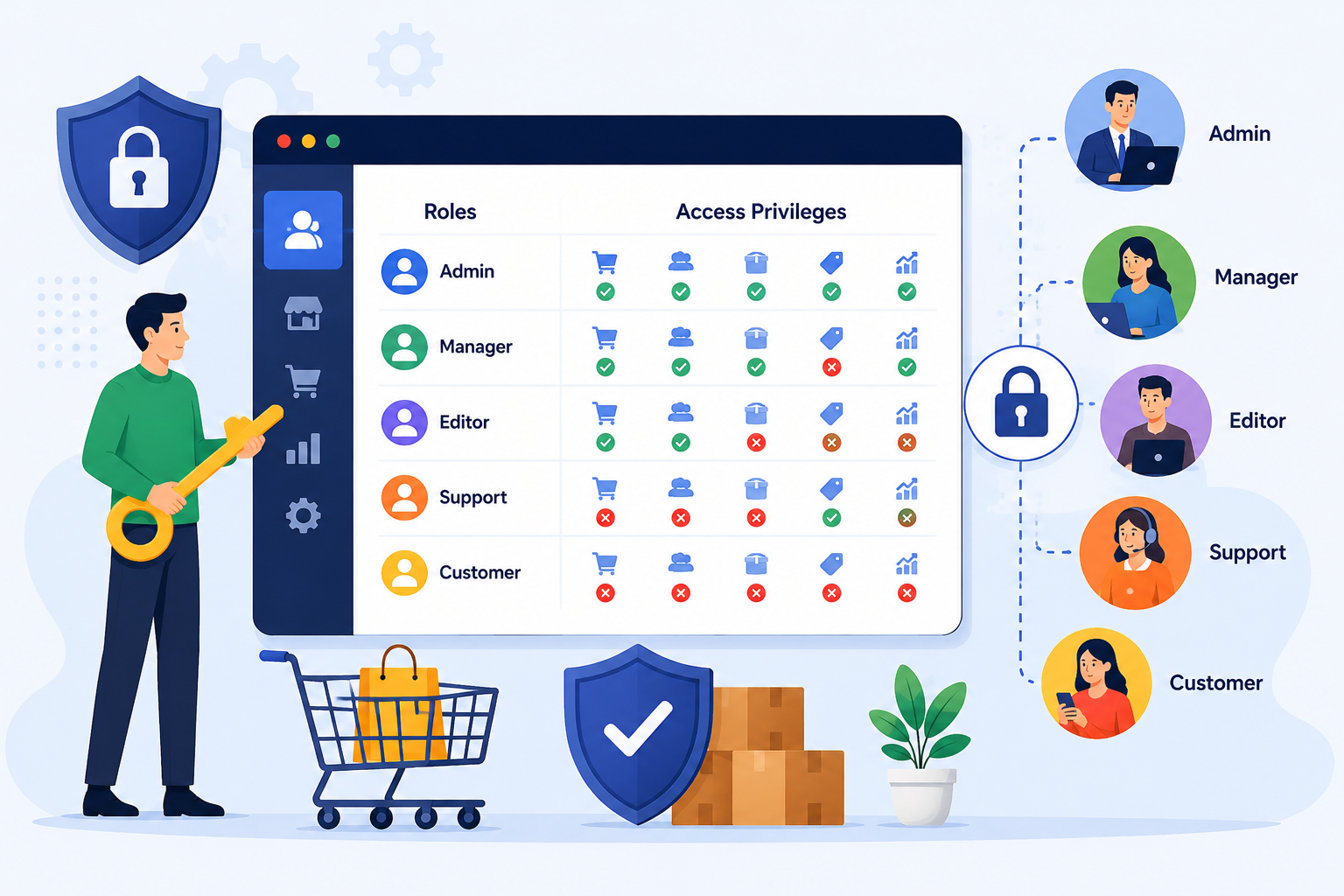
As your eCommerce venture grows, managing backend operations become more and more complex. But when one administrator manages everything from processing orders, answering customer queries and managing inventory to shipping, it can lead to inefficiencies and security risks. This is where the management of role and privilege is critically important. The right access for the right people can improve productivity, increase security and streamline operations for companies.
Let us visualize a scenario wherein you have set up a new ecommerce site for selling your products online. Obviously, you need to manage access to order and sales reports, processing orders, answering to customer queries and complaints, managing stocks, controlling prices and margins, and shipping orders.
With so many tasks to be done on an ecommerce site, it becomes obvious to assign these tasks to responsible employees. This is exactly why we create roles such as admin, inventory manager and report head, and assign privileges.
However, the admin privileges are not given to everyone. Similarly, shipping manager cannot enjoy the privileges of a stock manager, as he is only concerned with the shipping of orders.
Such a segregation of privileges not only ensures secured and timely management online but also faithful co-ordination and timely communication amongst the team in the backend. For implementing this segregation, here are some roles along with their privileges you should create in the administrator panel of your ecommerce site.
Why Role and Privilege Management Matters in eCommerce
Role and privilege management helps businesses assign the right level of access to the right employees. It minimizes unauthorized access, improves accountability, reduces operational errors, and ensures that every team member focuses only on the tasks relevant to their responsibilities. As eCommerce businesses expand, having a structured access control system becomes essential for maintaining efficiency and security.
System Administrator
This role has the privilege to create and maintain all other roles (users) along with their privileges at the ecommerce site. The administrator can create a new role, modify privileges, and delete an existing role or privileges as per the company’s decisions.
Product Administrator/Manager
This role has the privilege to manage all products at the site along with online catalog, set the right prices, and link them with the suitable partners. The product administrator can also play the role of stock manager for keeping a record of products in the warehouse and ordering for products that become unavailable online.
Order Administrator/Manager
As the name suggests, this role has the privilege to see the daily orders placed, process them as per the availability in warehouse, update and monitor orders, and pass them to the shipping administrator for quick delivery, if the processing part goes hassle-free.
Shipping Administrator
This role has the privilege to see the orders received for shipping online as sent by the order administrator and do all the arrangement at the backend for delivery. He/She is responsible for packing the products, adhering to packing standards, arranging for the right transport medium, and initiating delivery challans.
Accounts Receivable/Payable Representative
This role has the privilege to manage invoices on the site, such as those paid by the customers shopping online. He/She also manages the invoices triggered by the suppliers or partners whose products are sold on the site.
Sales Manager
This role has the privileges to manage the sales representatives, view total sales happening at any given point in time, and create/view sales reports.
Customer Service Representative (CSR)
This role has the privilege to view and track any product return requests, complains, or suggestions. The CSR is responsible for answering queries that might come through email, call, or any other medium.
Benefits of Defining User Roles in an eCommerce Store
Improved operational efficiency.
Enhanced security and access control.
Faster order processing and fulfillment.
Better accountability among employees.
Reduced chances of human error.
Easier monitoring and reporting.
Better collaboration between departments.
Channel Administrator
This role creates and maintains partner and supplier profiles. Each partner and supplier role then can view details such as products sold, products rejected, and total invoice amount raised for their own products.
Role-Based Access Control Supports Business Growth
As your online store scales, new departments and responsibilities emerge. A well-planned role and privilege structure allows businesses to onboard new employees quickly, maintain data security, and adapt to changing operational requirements without disrupting existing workflows.
In short, you can create roles as per your organizational chart and streamline the backend operations.By implementing a well-defined access hierarchy, eCommerce businesses can achieve a balance between operational flexibility and security. The result is a more organized backend, improved productivity, and a better experience for both employees and customers.
Understanding Role-Based Access Control (RBAC)
Role-Based Access Control (RBAC) is a security framework that restricts system access based on an employee’s role within an organization. Instead of granting permissions individually, businesses assign users to predefined roles that contain specific privileges.
For eCommerce businesses, RBAC provides a structured approach to managing access across departments while ensuring operational efficiency and data security.
Why Access Control Is Critical for eCommerce Businesses
As online stores grow, more employees become involved in daily operations. Without proper access controls, businesses risk:
- Unauthorized data access
- Accidental data modification
- Security breaches
- Operational inefficiencies
- Compliance issues
A clearly defined role hierarchy minimizes these risks and creates accountability across teams.
Key Components of Role and Privilege Management
User Roles
Roles define the responsibilities assigned to employees.
Examples include:
- Administrator
- Product Manager
- Inventory Manager
- Order Manager
- Customer Service Representative
- Marketing Manager
- Sales Manager
Privileges
Privileges determine what actions users can perform within the system.
Examples include:
- Create products
- Edit product pricing
- View reports
- Process orders
- Manage inventory
- Access financial data
Combining roles and privileges ensures employees only access information relevant to their responsibilities.
Security Benefits of Role-Based Access Control
Reduced Risk of Unauthorized Access
Not every employee should have access to sensitive information.
RBAC helps restrict access to:
- Financial records
- Customer information
- Administrative settings
- Business reports
This reduces the likelihood of internal security incidents.
Improved Data Protection
By limiting access permissions, businesses can better safeguard:
- Customer data
- Payment information
- Business intelligence
- Operational workflows
Data protection becomes increasingly important as eCommerce businesses scale.
Operational Efficiency Through Defined Roles
Faster Task Management
Employees can focus on their assigned responsibilities without navigating unnecessary system functions.
Benefits include:
- Increased productivity
- Reduced confusion
- Faster workflows
- Better accountability
Improved Collaboration
Role-based systems help departments work together more efficiently by clearly defining responsibilities.
Examples include:
- Product managers update catalogs
- Order managers process sales
- Shipping teams fulfill deliveries
- Customer service handles support requests
Additional Roles to Consider in Modern eCommerce
Marketing Manager
The marketing manager role may include permissions to:
- Manage promotions
- Create discount campaigns
- Analyze marketing performance
- Monitor customer engagement
Content Manager
Content managers typically oversee:
- Product descriptions
- Blog content
- Landing pages
- SEO optimization
Vendor Manager
For marketplace businesses, vendor managers may handle:
- Seller onboarding
- Vendor performance tracking
- Marketplace compliance
- Product approvals
Improving Accountability and Auditing
Activity Tracking
Modern eCommerce systems often maintain audit logs that track:
- User logins
- Product changes
- Order updates
- Permission modifications
This helps identify who performed specific actions and when they occurred.
Performance Monitoring
Managers can evaluate employee productivity through role-specific activity reports and workflow analytics.
Supporting Compliance and Governance
Regulatory Compliance
Many industries require strict access controls to meet regulatory standards.
Role management helps businesses comply with:
- Data privacy requirements
- Security standards
- Internal governance policies
Risk Management
Clearly defined privileges reduce operational risks and improve business continuity planning.
Role Management for Multi-Vendor Marketplaces
Marketplace businesses require additional access controls because multiple vendors operate within the same platform.
Vendor Access Restrictions
Vendors should only access:
- Their own products
- Their own orders
- Their own reports
Marketplace Administration
Marketplace administrators retain control over:
- Vendor approvals
- Commission settings
- Global platform configuration
- Marketplace analytics
This separation ensures data privacy and operational integrity.
Best Practices for Implementing Role and Privilege Management
Follow the Principle of Least Privilege
Employees should receive only the permissions necessary to perform their duties.
Benefits include:
- Improved security
- Reduced risks
- Simplified administration
Regular Permission Reviews
Business requirements change over time.
Conduct periodic audits to:
- Remove unnecessary access
- Update role definitions
- Ensure compliance
Use Multi-Factor Authentication
Combining RBAC with strong authentication provides additional protection against unauthorized access.
Common Mistakes to Avoid
Giving Excessive Permissions
Overly broad access increases security risks and complicates management.
Using Shared Accounts
Each employee should have a unique account to ensure accountability and accurate activity tracking.
Neglecting Access Audits
Regular audits help identify outdated permissions and improve security posture.
Role and Privilege Management in Cloud-Based eCommerce
Cloud-based platforms increasingly support advanced access management features, including:
- Granular permissions
- Single sign-on (SSO)
- Identity management integration
- Automated role assignment
These capabilities help businesses scale securely and efficiently.
Future Trends in Access Management
AI-Powered Security
Artificial intelligence is helping businesses detect unusual user behavior and prevent unauthorized access.
Zero Trust Security Models
Zero Trust frameworks verify every access request regardless of user location or device.
Advanced Identity Management
Modern identity solutions provide centralized user management across multiple business applications.
Frequently Asked Questions
What is role-based access control in eCommerce?
Role-Based Access Control (RBAC) is a system that grants users access permissions based on their assigned responsibilities within the organization.
Why is privilege management important?
Privilege management improves security, reduces operational errors, and ensures employees only access information relevant to their roles.
Can role management improve productivity?
Yes. Clearly defined roles reduce confusion, streamline workflows, and improve operational efficiency.
How often should user permissions be reviewed?
Businesses should review permissions regularly, especially after organizational changes or employee role updates.
Conclusion
Implementing role and privilege management is essential for maintaining secure, efficient, and scalable eCommerce operations. By assigning the right access to the right employees, businesses can improve productivity, strengthen security, enhance accountability, and support long-term growth. As eCommerce operations become more complex, a well-structured access control framework becomes a critical component of successful business management.